The Hero

by B. Robert Meyer

Juan Martinez (this is a pseudonym) is hard to look at.  When he sits in our waiting room before coming into my office the other patients and their family members all notice him.  Some try not to stare, but inevitably sneak peeks out of the side of their vision.  Others look away because he is indeed very hard to look at.  Mr. Martinez has grown accustomed to this reaction, and he has learned to ignore them.  He also has learned to dress in a way that limits his exposure.  He wears a stocking cap sometimes even in the summer.  It covers his scarred skull, from which occasional strands of straight black hair poke upward.  It at least partially covers the holes that serve as ears, surrounded as they are by some feeble attempts at external ear tissue.  Long sleeves cover the scars on his arms and the areas of heaped up keloid tissue that restrict their motion.  His hands are really best described as “mittens”, with scars connecting the fingers and with only a few minimal stubs for fingers.  One side has but two (a stiff thumb and index finger).  The other really stops at the palm. The arms and hands are not flexible and are not really able to grasp or hold most objects.  A knife or a fork would be hard.  A large and square object like a box, yes he could hold that.   But he cannot wear gloves to hide the hands because every time anything brushes up against his hand he has a paroxysm of pain that can shoot up into his arm.   (Have you ever hit your funny bone and felt that pain in your arm?)  Mr. Martinez gets that often in his hands.

But he cannot cover his face.  And that is what people notice.  He has lost his eyebrows on both sides, and has no discernible eyelashes except for three isolated lashes that poke out from a lump of skin tissue that serves as his upper eye lid on one side.  The rest of his face is scarred.  Most of his nose is gone, replaced by a flat and minimally protuberant organ with two holes.  He has heaped up scar tissue on both sides of the face.  The scar tissue runs down into the neck under the jaw to the top of the rib cage. It is lumpy, gnarled, and has periodic areas where hair follicles protrude and where there is occasionally some drainage.  Were you to see his neck and chest you would see that he has a scar where he had a tracheostomy and the same twisted, discolored, and heaped up scar tissue on his neck that includes much of his chest. When he walks, he walks stiffly because he cannot swing his arms as much as a normal person, and because he has some limitations in his legs from scarring there as well.

Once he is in the exam room and you speak with him, the bad visuals go away and you begin to like him.  He has a soft voice.  It is easy to hear and understand.  And he is very articulate.   He is almost always accompanied by his wife.  She works evenings as an office cleaner and can usually find the time during the day to come with him.  She is a solid, smiling presence at his side.  She lets him talk, listens to what he has to say, and offers her own insights when appropriate.   They look at each other with love in their eyes.  Occasionally he is accompanied by one of his two daughters.   They are beautiful young women in their late teens or early twenties I would guess.  They too, look at their dad with unfettered love and adoration.

You see, their dad is a hero.  He has been thru 8 months of continuous hospitalization (4.5 months in the ICU and 3.5 months or so after that on a regular medical floor or rehab unit)  The ICU months were in our burn unit on a respirator for most of that time.   There were daily dressing changes. Have you ever poured water on a cut and felt the burning pain? Try to take a bath in a tub in which that cut covers all of your head, neck, shoulders, arms, hands, and part of your chest….And do that every single day for months at a stretch.  Try doing that with a tube in your throat, or with a breathing tube in a tracheostomy on your neck, where the lining of your airway is on fire with every breath.  And then throw in perhaps two dozen or more surgical procedures to get rid of damaged skin, to try to maintain some structure for the ear or the nose, or the lids and the lips.

But that does not make their dad a hero.   What made him a hero is also not the headline in the paper declaring him one.  What makes him a hero is that while he was working as a night doorman in a fancy building on the east side, he smelled smoke.  He called the fire department, and then he ran into the building to save the tenants. He ran down the hallways, banging on doors, leading the tenants down the stairs, inhaling the smoke, holding open the hot door handles, helping people to escape.  And he did this so well that all of them got out safely and with only modest injuries.   When the Fire Department arrived he was the person most seriously injured.  The F.D.N.Y. put out his flaming clothes and hair, gave him oxygen, and took him to our burn unit for care.

That was years ago now.  When I meet him for the first time he has been out of the hospital for a year and a half.   Now, going on 3 years since the fire, life has changed.  He is at home.  He can manage by himself at home when his wife is at work.  She sets out his medicine and makes sure that there is something to eat before she leaves for work.  His daughters are still in the home and when they are not at school (they are both in college) they help him as much as he needs.  He gets some disability payments since he can no longer work.  Between his wife’s work cleaning offices at night and the disability they manage to make ends meet, but just barely.  There is nothing to spare.  But they have a roof over their heads and the family is managing.

He has three major concerns that we usually discuss during his visits:

The first concern is controlling his pain.  He does not want narcotics for the pain, fearful that he will become a drug addict and start mugging people on the street for money to buy heroin.   I tell him not to worry about this.  Aside from the fact that he would be the ugliest drug addict in the world, I tell him, he would also be completely incapable of pulling off a mugging or a hold up.  He smiles.  But more importantly, I tell him we can try other medications and we can keep the narcotics available to him to use for those times when the pain is acutely bad and unbearable.  I am not opposed to giving him narcotics, provided we have some guidelines about when and how to use them. I trust this man to follow the rules we set.  We tinker, adjust, and try to provide him with some relief.  We never really get rid of the pain.  But we do, I think, manage to make it tolerable and he can manage to find a way to live his life with the pain.

His second concern relates to the burns….He has these areas of heaped up scar tissue on the face and neck.  These areas were once the source of facial hair and sweat glands.  Periodically, one of these scarred glands decides to try to do what it was originally designed to do.  It tries to grow a hair or produce some sweat.   But the gland (wherever it might have been originally) is now often deeply buried in the heavily scarred surface of his face and neck.  The hair or the sweat struggles to get out.  In that case he will suddenly develop what looks like a boil or an abscess.  And then it swells, becomes tender, and eventually drains to the surface.   We do our best to handle each of these events as they happen.  That means gentle soaks, some antibiotics if they are warm or particularly red (that is hard to see in his case) and eventually they calm down and resolve, or recede into the scar tissue.  Often, it seems, this is only a temporary victory.  They shall return.

His third concern is one we are actually glad to be able to talk about.  He has not been home to his native country since the fire.  He has not seen his parents, brothers, sisters, aunts and uncles since this happened. He is finally physically strong enough to be able to think about the trip….The air trip, the travel from the airport once there, feeling well enough to stay with his family, now all of this seems (finally) now approaching 5 years since the fire, to be manageable to him.  He would like to go home to see them again and visit…..But he is frightened about what they will see….He has tried to tell them what has happened. He has even sent a few pictures.  But he knows that they will be shocked by the new reality before them.  Will they see him inside this new exterior?.  Will they act like the people in the waiting room?

I tell him, “They will see a victorious hero coming home with his beautiful family and will be proud. Perhaps they will have a fiesta to celebrate your visit.”

He smiles, but does not quite believe this.

Do you know? He says one day.  “No one from the building has ever thanked me.  No one ever came to the hospital when I was sick, and no one called my wife or asked how I was doing.”


Bob Meyer is a retired primary care physician and medical educator.  He has been a member of LP2 since the fall of 2023.
Through the Looking Glass

by Mary Padilla

Recently I came across a first novel by a contemporary playwright that consisted largely, and not surprisingly, of dialogue. It seemed an appropriate format in which to explore two opposing perspectives on what seemed at the time to be life, the universe, and everything.

I refer to a contretemps with our preverbal child.  At this point I already knew that I was outclassed in our interactions. There seemed to be a desperate need for independence on her part, and I was later to learn not to exacerbate matters, confining my interventions to health and safety issues like tackling her when she was inspired to dart out into traffic.  But I was a new mother, and this happened at an early point in my learning curve, when I had idealistically well-intentioned hopes of understanding and communicating by sharing our thoughts and feelings.

But how to convey her point of view?  This wasn’t going to work as an opportunity to use dialogue, for I had been on the receiving end of unintelligible ejaculations that conveyed primarily rage.  It was equally clear that she was far from comprehending me.  Stream of consciousness, then?  But if I could have understood her thought processes in the first place there wouldn’t be a story here.  And she clearly appeared neither capable of nor interested in understanding mine.

I decided to see if I could find examples of young toddlers’ communication styles to refresh my possibly repressed memory.  YouTube, I discovered, is rife with calm experts in Early Childhood dispensing analysis and advice to overwhelmed parents.  Tantrums happen when the child’s prefrontal cortex goes off-line in response to what appear to be life-threatening challenges to autonomy, so perceived by the amygdala at the least hint of frustration.  You can’t try to talk them down, as their brains aren’t listening, and they don’t understand words anyway.

All this rational counsel was delivered as voice-overs accompanying videos of little kids energetically and loudly losing it in a variety of contexts.  It was such a vivid reminder of what it had been like trying and failing to cope with this situation that it transported me instantly back to that time and how it had felt.  And it came as an immensely gratifying relief to be able make it all go away immediately with a single click and to know that it wasn’t part of my reality anymore.

So mesmerizing was it to watch these clips that I’m certain that had they been around then that I would have become addicted to binge-watching them, however disheartening it would have been if – no, when – trying to put their advice into practice didn’t pan out in the real world.  I know I would have kept searching for the clue that was going to crack this seemingly insoluble conundrum, because I hadn’t found it in all those books on parenting.

But after all this preamble, now on to the actual incident, first from my perspective.  Our daughter slept in a crib.  It was the same one that she had used since coming home from the hospital.  Nothing had changed.  Except that something clearly had, since one night a while after putting her to bed there came a THUMP from her room. Rushing back to determine the source of the sound, I found her on the floor.  She had climbed up and launched herself over the guard rails.

What could she have been thinking, I wondered.  There was no point in asking, and anyway she was too busy screaming to have spoken, had she been capable of speech.  After much weeping, wailing, and gnashing of incipient teeth and with her having evinced no evidence of being willing to be held and comforted, I put her back in the crib and tucked her under the covers.

All was quiet, briefly… until, not long after, there came another THUMP.  Same story – child on the floor, expostulating inconsolably and, of course, unintelligibly, but LOUDLY.  Nothing wrong with the bars.  What would YouTube say?  Well, at this time there was no internet, so Early Childhood experts not being so accessible in the middle of the night, and in the absence of other obvious options, back she went into the crib.

But shortly thereafter, and not surprisingly, there ensued yet another escape.  It being unlikely that I could produce a different result by repeating the same response, I capitulated, took the mattress out of the crib, placed it on the floor, and put her and her blanket on top of that.  How else, after all, was she ever going to develop a sense of agency?  We built her a bed the next day.

That’s how it appeared from my perspecive.  Hers I can only imagine.  Based on what I was to learn about her sense of justice and self-worth over the next 45 years, here is my reconstruction of her likely thoughts:

She is so clueless.  To get through to her you definitely have to take the direct approach.  And it takes her more than one repetition to get it. I go to all the trouble to break out of this jail and what does she do – put me right back in!  So, at significant peril to life and limb, I’m forced to escape again and again to get the point across. And while this is going on, all she can do is to make those annoying unintelligible noises at me, as if that’s supposed to convey some justification for this gross injustice.  She seems incapable of learning.  How could I not be indignant over such disrespectful treatment – putting me back where I so clearly don’t want to be and then expecting me to stay there just because she’s bigger than I am and happens to know how to walk. That’s blatant discrimination and an unjustifiable power play.  I’ll show her.  Once I learn the local language and get some steps in gear, I’m outa here.  And it starts right  here, right now.  I refuse to acquiesce to incarceration just because I’m not considered developmentally mature enough to make my own decision in this matter.  Give me a place to stand on the floor, and I can move the world!

In the interest of fairness when preparing this piece, I asked my former antagonist for her recollection of this particular incident, arising out of what seemed at the time to be a continuous maelstrom of clashing perspectives.  She remembered climbing, but not falling, and not her rationale.  And she also volunteered that other people’s perspectives didn’t figure highly in her world view at the time, adding the parenthetical “unfortunately.”

After this was written, I sent her a copy.  Here was her response:

Highly amusing.  I think it was probably something more along the lines of “Wait, it IS possible to be over there and not here.  All I have to do is… Wait, wtf just happened, and why am I on the floor?”  Repeat.


I write to think things through.


Medical Whack-a-Mole

by Pat Fortunato

Whack any moles lately?

Bet you have. It’s sad but true that unless you’re obscenely young, you have a fluctuating variety of minor (we hope) medical ailments popping up all the time.

It is truly like playing Whack-A-Mole. Only with doctors.

Sometimes it’s literally a mole. The dermatologist gets to whack that one. But then it’s your back. Did you strain it? Sprain it? What’s the difference? Can anyone ’splain that to me? Anyway, next day the back pain is gone, but your Go Pro (also known as the Squatty Potty) is not doing its job. Or the Activia is doing it a bit too well and you have unscheduled bonus rounds you could do without. This gives new meaning to the words Game of Thrones.

The next day you’re fine in the poop department, but you feel like shit anyway because you didn’t sleep the night before.

But then, you do sleep well, so you feel like doing some serious walking. Whoops. Forgot about that thing going on with your feet, so that even wearing those hideous shoes only a podiatrist could love cannot prevent your feet from feeling rotten.

Listen To Your Big Toe. No, really.

Remember those stories about farmers who could tell when it was going to rain by their aches and pains. It’s true! Well, sort of. Something about the low pressure on the outside letting your inner pressure do whatever it does to make something hurt. And that’s our science lesson for today.

Meanwhile, my big toe feels fine, but I ate something for lunch that didn’t agree with me. Didn’t agree with me? What the bleep does that mean? Did I say something that offended the tuna fish? Is the peanut butter angry because I prefer smooth to chunky? I’ll never mention that again, Skippy, I promise.

And don’t get me started about doctors. You have so many of them that even your specialists have specialists. I suspect that if I went to my podiatrist about my big toe, he’d send me to someone who specializes in small toes. Or pinky toes. And if one of these specialists doesn’t find something wrong, the next one will. Guaranteed. To me, the word “specialist” means that they specialize in referrals.

Where is Doc Martin when you need him? 

He’s the doctor on British TV who treats everything, and if you can, watch him on one of your streaming services or YouTube. It won’t cure your ills, but for 45 minutes, you won’t care. And there’s no co-pay.

https://www.youtube.com/watch?v=Abdel1jWLzw

But alas, back in the real world, you get to a certain point, all too quickly I’ve discovered, when you have a whole list of recurring “moles,” like digestive problems or acid reflux, with nifty acronyms like IBS or GERD. You also may experience more exotic conditions like peripheral neuropathy (a hands and feet thing), vestibular hypofunction (that’s an inner ear problem). Or more common ailments like hearing loss (WHAD’ya say?) or neck pain, probably from the tension of worrying about all the other whack-a-moles.

And this can make you feel OLD. One elderly woman, walking out of my building, said to her companion, “I wonder what will hurt today.” Happily, they both were smiling. If you haven’t already, please develop a finely honed sense of humor as soon as possible. You’re going to need it.

In the immortal words of Roseanne Roseannadanna, “If it’s not one thing, it’s another.”

And if you’re reading a piece about medical whack-a-mole, you probably recall the Gilda Radner character from SNL who said that. On the other hand, if you’re old enough to remember, you probably suffer from some memory loss, so go directly to YouTube where she holds forth on the dangers of smoking and Other Things.  Laughter, as the saying goes, is still the best medicine.

Not to get all morbid about it, but Hamlet, contemplating whether to off himself or not, kinda agrees with Roseanne when he speaks of “the thousand natural shocks that flesh is heir to.” Face it, even that hangnail is seriously annoying.

We must remember, however, lest we become, god forfend, depressed (involving a therapist who probably won’t take your insurance), that however many moles you whack today—or tomorrow and tomorrow and tomorrow. . .

It’s much better than the alternative.

After Pat left publishing (or perhaps it was the other way around), Pat started a blog called I Can’t Believe I’m Not Bitter, which morphed into My Age is Unlisted. These days Pat is  posting on Substack, which, Pat is  told, is the new hot thing.


Home Leave

by Mireya Perez-Bustillo

Like rapid fish, the sleek tan bodies dive for coins they catch in their mouths tossed by tourists from the towering cruise-ship. Amid the iodine-impregnated air, the boys paddle out in fragile canoes in the blue-black Bay of Cartagena, where the sea sinks to slumber to clasp the city in an embrace. Here, where the largest slave market from Africa prospered in the 18th century, where the viceroys once lived in the Old City, surrounded by six foot walls, pockmarked from cannonballs shot from the ship of Sir Francis Drake. Here, the alert watchtowers welcome Reyna and her family back home.

The smell of coffee beans rises from piled sacks on the pier as the ship reaches port in safety. Soon, Mami welcomes aboard Henya, her almond-colored old nanny. Over there is Tio Aquiles, Tias Marta, Clara, and Soledad, cousins Alicia, Pable, Mario, Sofia, Alberto and Eduardo. They have three hours to visit while half-stripped stevedores the same color as the coffee beans spilling on the docks unload the ship. With each embrace of another welcoming relative, Reyna notices Mami and Papi’s faces light up, their shoulders melt in ease. This is home. Nobody stumbles over their names. No one asks Reyna about the holes in her ears or why she wears earrings. The hugs, the kisses on the cheek, the familiar abrazo between men walking with their arms clasping each other’s shoulders, the women holding hands or walking arm in arm, the joking among the men, the women admiring Mami’s Fifth Avenue dress and shoes, Papi, being greeted by one of his former students now a customs official, the ease of hearing their name recognized. Here the people knew who they were.


Mireya Perez-Bustillo’s fiction in Spanish and English appears in Revista del Hada, MER VOX, Caribbean Review, among others. Her Latina coming-of-age novel, Back to El Dorado (Floricanto Press) is available on BnN and Amazon sites.


Christmas Eve, 2025

by Judith Meyerowitz

As if seasonal, pulsating red lights enter my second-floor apartment. There is no noise. The red glow is almost warming on this chilly Christmas Eve. I separate the blinds with my fingers, but the building scaffolding allows me to see only the top of the emergency vehicle which looks like neither police car nor ambulance. It is white with a low roof that ends in graceful wings.

I hear behind me a shuffling of steps and the voice of the woman next door who I have heard shouting in the hall at times or crying through our shared bathroom wall.

I think of their barely school age daughter. I never see either of them.  Do they go outside? When the mother bangs the walls or yells, “I want to break things. I want the knife,” is the daughter watching and when her mother is taken away?

Christmas Eve is an emotional trigger.  Their dog madly barking/crying in the apartment as moments ago its owner had been. It was not a good holiday for the dog either.

There had been a light tap at my door minutes earlier.  Was it the child? the mother? Narrow views through blinds and peepholes. I do not want to know too much.

I assume the small family next door will go on as before.  He wears a University of Texas tee. Isn’t that normalcy?

I see a police officer, a young child, a dog drop from peephole sight as each descends the stairs. The red glow flashes hypnotically between my blinds but disappears as the winged rescue vehicle rises quietly over the tall buildings on Lexington Ave. The only sound is of the dog barking.


Judith’s writing interests have deepened after taking the Writing Workshop sg for several semesters. These experiences have led her to explore other writing classes at the 92nd St. Y where this prose piece was developed. 


Curio Cabinet

by Judith Meyerowitz

I look at my curio cabinet with awareness of kunst-wunderkammer, the 16th c Cabinet of Curiosities, the earliest of museums, but I suspect the collecting desire started with the rock age.

I think about wunder and wonder. My mind goes to Freud’s display of antiquities, the wood and glass a reminder of visiting his office outside London. His museum of mind, the space to reflect as well as mine.

The world of my travels I have placed under glass like a towering snow globe. Americana folk art ice cream man smiles at Spanish lady in an overflowing colorful dress of many layers, a large figure from Provence Marseille fisherman greets Polish peasant woman holding a rake, and Caribbean steel drummers back up a Mexican guitarist. Many of my pieces are chosen with spiritual ties: Day of the Dead shrines, nativity scenes, mezuzahs, and Ancient American god.

I note that these early museums were called “memory theater” and think of it as a stage set for my pieces behind a glass curtain whose doors open to the magical.

It is a miniature world, and I often move the pieces around- visually compose them in relationship to each other, restage them.

In the large real-world museum, I am a docent but, here I am the curator.

There are no preserved insects, taxidermy, nor fingers of saints in my museum.

My figures are artifacts from an earlier life period.

Dust enters between the doors, settles on all. I have not traveled for quite awhile.


Judith’s writing interests have deepened after taking the Writing Workshop sg for several semesters. These experiences have led her to explore other writing classes at the 92nd St. Y where this prose piece was developed. 

English Lessons

by Jennifer Roberts


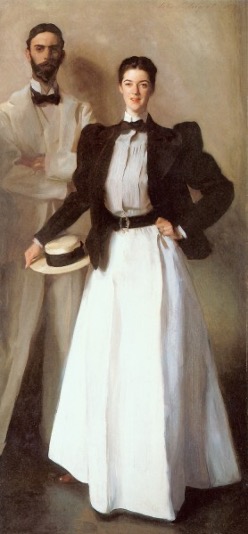
  [John Singer Sargent, “Mr. and Mrs. I. N. Phelps Stokes,” 1897.  Metropolitan Museum of Art]


Man around 50 in trenchcoat, with glasses, stands in front of the painting. A woman of about the same age approaches, neither dressed up nor dressed down. They make eye contact.


He: Is good art.

She: Yes. You like Sargent?

He:  No, I am Captain.

She, laughing: No, I mean the painter, John Singer Sargent.

He: English?

She: American.

He: Speak English also in America.

She: Yes, we do.

He: I am not know good English. You teach me?

She: Where do you come from?

He: I come Koldova. Speak Koldova. Captain in Koldova army.

She (suspiciously): Really? That’s funny, I never heard of…Koldova. Where exactly is…Koldova? Was it part of the Soviet Union?

He: Yes, we have many onions.

She: Right. Whatever. So how shall I teach you English?

He: You have house?

She: Well, I have an apartment.

He: Is big?

She: Not very.

He: One bedroom?

She:  Two, but I turned my daughter‘s room into a study when she went to college.

He: One bed?

She: Yes, only one.

He: I sleep in bed with you.

She: Uh…I guess you would have to.

He: I fuck you.

She: Uh…well…I guess that would be okay.

He: We fuck before or after English lesson?

She: I suppose… both?

He: We fuck also during English lesson.

She: Well, I think—

Cell phone rings in man’s trenchcoat pocket.

He: Hey, Trace. Oh my gosh, you’re kidding! To woman: Tracy got the job! They want her to start next week!

She, grabbing phone: Sweetheart? Dad says you got the job! That is so fantastic. So proud of you. Us? Oh, nothing special. We’re just playing a game we sometimes play. No, not Scrabble. It’s…it’s hard to explain.


A wisecracking grandmother and a native New Yorker who has taught in both Texas and Massachusetts, Jennifer Roberts is currently Distinguished Professor of Classics and History at the City University of New York and the author of several books on Greece.


The Decision

by Jennifer Roberts

“I’ll be taking Spanish.”

My Sorbonne-educated mother greeted this news with an expression more commonly seen after announcements like “I’m pregnant”  or  “No, he’s not Jewish” (phrases sometimes combined in a single sentence).

Maman’s entire world seemed to collapse like a soufflé.  Why would anyone choose Spanish over French?  Sure, Spanish had a certain practical value, but without French I would never be able to appreciate Molière or Montaigne or Flaubert or Voltaire or Hugo or Camus or….  And not only that.  What would I make of the work of Renoir, Monet, Cezanne, or Degas? And I could just forget about listening to the music of Debussy, Ravel….

Sacre bleu! What was the world coming to?

In vain did I point out that I had been enjoying Renoir and Monet and Debussy for some time (my mother had seen to that), and that there were, after all, such things as translations.

My mother was convinced that I was taking this bizarre path simply to spite her.

She was mostly right. It is true that I had been exposed to Spanish and come to love it when my father was working in Venezuela, but it was also true that I have always been disposed to take the opposite path from the one my mother had mapped out for me. Since my mother was a fairly sensible person, the results of this have often been pretty dreadful—I forbear to mention my first marriage*—but there you have it.

I did, however, have a bit of Spanish under my belt, with the result that while my classmates had to choose between Latin and Ancient History, I would be placing out of eighth grade Spanish and taking them both. I would then join my classmates in ninth grade Spanish.

You see where this is going.  That was 1959.  Now, 67 years later, my job consists primarily of teaching…. You got it.  Latin and Ancient History.

I don’t mean to suggest that opting for Spanish over French doomed me to study antiquity for the rest of my life.  Au contraire: there was a second event, quite possibly a divine intervention.  I am not great at math, but my grandfather was a mathematician, and math always interested me enormously.  Having completed differential calculus by the skin of my teeth in high school, therefore, I decided to enroll in integral calculus the first semester of college.  As I had played several instruments, moreover (albeit none of them very well), I thought I would flourish in Harmony.  Well, I failed the first calculus exam with a 25, but no worries; so did a few others, so the instructor offered a make-up exam.  Failed that one with a 16. And in the lunchroom I overhead a young woman saying, “You’ll never believe the stupid questions this girl asked in my harmony class.” Yup, they were my questions.

Suddenly I was in dire need of a class that met M W F morning.  So I headed to the administration building for a tête à tête with the dean.

“I see you had a couple of years of Latin in high school,” she said.  “Cicero’s Letters meets M W F at 10….”

And voilà, I became a Classics major.

__

*Footnote:

The words “I forbear to mention” remind me of one of the joys of teaching Latin, namely teaching students about the rhetorical art of praeteritio, by which a speaker calls attention to a subject by claiming to pass over it.  Cicero against Clodius, 56 BC: “I forbear to mention that he sleeps with his sister.” Latin has its uses.


A wisecracking grandmother and a native New Yorker who has taught in both Texas and Massachusetts, Jennifer Roberts is currently Distinguished Professor of Classics and History at the City University of New York and the author of several books on Greece.


Acts of Defiance – on hair and bare arms and barer legs

by Meera Kumar

In an act of defiance, I walked into a beauty parlor in Northern Nigeria and told them to chop off my knee length hair and shape it so that the long tresses would remain no more than 2 inches in length. When I came out of the salon, even the driver waiting to take me home took a double take as he wondered if he was driving the right person away. As I tell this story, I need to explain why this simple, everyday transaction between the hair stylist and myself took on the dimensions of defiance.

I grew up in India where the concept of beauty, a pre-requisite for finding a good match in the marriage market, required that hair be kept as long as it would grow; in addition a center part was mandatory because on the wedding day, the groom would fill it with the red vermilion that would signify my married status, a privilege denied only to those who became widowed. I’d always wanted the “modern” look, that I saw frequently in the magazines that came to us in the 60s. My pleas with my mother, that I would like to keep short hair, were always met with disapproval and rejection because, as she explained, as short hair just wouldn’t look good on my wedding day, when I was expected to wear the obligatory red sari and cover my head with the gold embellished pallu. The real fear lurking in my mother’s heart, and one she expressed sometimes, was that the future in-laws may reject a girl with short hair as she would be perceived as independent, a tad unconventional, perhaps too “fast”. The word “fast” encompassed all the traits that mothers-in-law in search of compliant, conventional daughters-in-law would reject outright.

I had experienced similar disapproval from my grandparents when a family photograph was sent to them, a photo in which I was wearing a sleeveless tunic. When I look at that photo I see myself in all the demure innocence of my 13 years. But my grandparents took strong exception to the revelation of my arms and telephoned to admonish my parents about such an unseemly display of the flesh. It is not hard to imagine how outraged they must have been because long distance calls – called trunk calls in India at that time – were expensive and reserved for special occasions or emergencies. Clearly the sight of their 13 year old granddaughter with bare arms was a grave risk to the family’s sense of honor. What would the relatives think? More importantly, where could this display of independence lead and how would it fit into the expectations of the future in-laws? Sadly for me, my parents, either out of filial duty or silent acquiescence, forbade me from ever wearing that tunic again unless I covered my arms with a sweater. I still remember the design of the tunic – white cotton with a spray of blue flowers, perfect for a summer day.

Realizing that there was no convincing my parents of the absurdity of their position, I found a way out. I wore that tunic repeatedly, incessantly, but even on a hot day with a sweater on top. And the moment I was out of the grown ups’ prowling eyes, off came the sweater revealing my rather well rounded arms gleaming in the glow of independence.

My friends were going through a similar dilemma – how to keep parents happy and let them cherish their dreams for our future while expressing a personal predilection for a different path in life. One friend, repeatedly denied this exercise of individual choice by her parents, had the courage to chop off one of her two braids leaving her parents with no alternative but to accept both her individuality and her short hair. But I didn’t have that courage until I found myself bored on a sultry warm afternoon in Nigeria where I had gone to live with my husband. I figured I was now married and the red vermilion ritual over so, well, I would do something daring.

I was met with some disapproving looks on my next visit to India. My mother seemed shocked when she came to pick me up at the airport but I was now married and someone else’s charge. I imagine her feeling was – let them deal with it. My in-laws made some noises about the beauty of long hair but knew better than to say more to a daughter-in-law who had navigated her way through several years in New York and was now on assignment in Nigeria. The hair remains short to this day although I wonder about those long tresses sometimes and think of the dust heap to which they must have been consigned.

As I have aged and the hair has thinned I regret the cavalier attitude I took to those long thick tresses that once adorned my head – is there some way to get them back from Northern Nigeria and replant them on my head – yes, I know I could use a fuller head of hair today.


Meera has lived and worked in close to a dozen countries; she loves to share her cross cultural experiences.

Jack and the Beanstalk

by Denise Heebink

An ignored, beat-up box sat in a corner for years. One of many my parents brought from their home in rural Wisconsin when they drove out to visit me in New York. The boxes might contain family artifacts—letters, doilies, a cutting board that “belonged to your grandmother,” or old photographs. Things that would not let me forget where I came from, or perhaps as likely, things my mother could not bear to throw out.

I opened the box and found a children’s book, more of a pamphlet of 10 pages. The colorful paper cover featured a young boy holding an axe and his mother a broom, both staring up at a gigantic tree with pods hanging from its branches. The title was Jack and the Beanstalk, copyright MCMXXXIV (1934) by The Platt & Muck Co. My grandmother Min had several similar story books, but this one had landed in my hands. They were always kept in the East Lake dresser near the stove and sofa, which was covered with scratchy red wool upholstery.

Holding the book, I again could feel the scratch of wool on my bare legs and smell the scents of food, farm, and cut green grass. I remember her hands were thin and fingers very long. What amazed and startled me were the thick blue veins that snaked across her liver-spotted hands. I liked to flatten the bulging vessels with my finger and watch them pop back up when released. Simultaneously, they fascinated and creeped me out.

Calm and comfort came over me when Grandma Min began reading this book. “Once upon a time, there lived a poor widow who had only one child named Jack. She spoiled him by giving him everything he asked for, so he grew up lazy and disobedient.” Her diction was careful and precise. She had gone to college and been a schoolteacher in a one-room school. Later she married my grandfather, a dairy farmer.

Now and again while reading, the phone would ring. I loved that. Our phone at home was a stylish, beige wall unit with a very long cord. Min’s was a wooden box installation with a separate black, funnel-shaped piece that you placed over your ear to hear and a round receiver to speak into directly. The bell on the box announced a call with a musical ring, and the operator, Nellie, would connect you with someone who was likely local. No one made expensive long-distance phone calls then, except for emergencies and deaths. It was a party line, and anyone could listen in. Naturally, Nellie knew everything.

Many decades of my life have passed since reading Jack and the Beanstalk with Grandma Min. Holding this book now and looking at my own hands, I am startled to find that they look just like hers.


Denise is a semi-retired psychiatrist in New York City who seeks a voice to describe a life of abundance and returns.